
I have been testing what is the best way to fold swimwear for both men and women for over a year now. And I have concluded that generally, a simple fold is best for both swim trunks and two-piece bikinis.
- Lay the swimwear bottom flat with the top facing up.
- From the left side, fold the bottom over in half so it lines up with the right side.
- From the top of the waistband fold in half down to the bottom.
- For bikini tops, lay it flat with the back facing up.
- Tuck the shoulder straps inside the cups of the bikini top.
- Place bikini bottom inside one of the bikinis cups.
- Fold the empty cup over the cup with the bikini bottom inside.
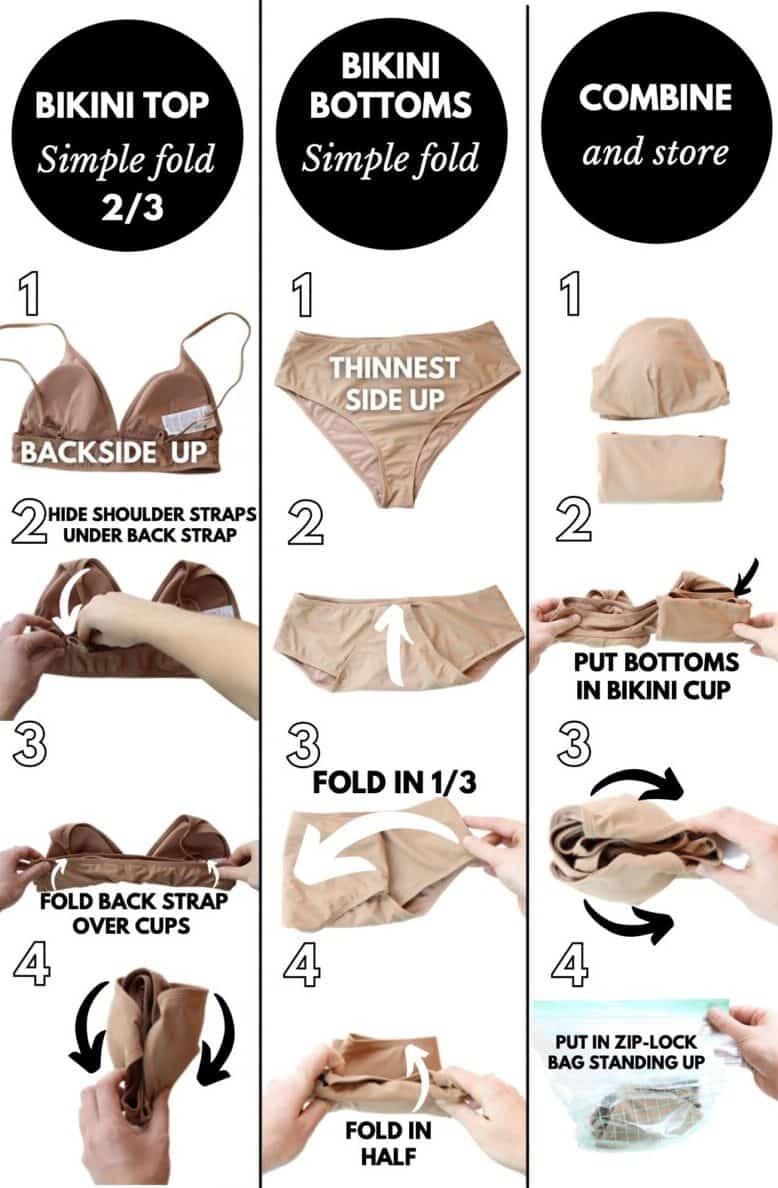
This works great to keep the shape of the cups, while also keeping matching sets of bikinis together. For men’s swimwear follow the first 3 steps for a simple fold. I will now go further into detail about what folds work best for specific types of swimwear. There are some great ways to save space for certain types of swimwear.
I have also added videos and illustrations below so that you can easily follow along. At the bottom of the article, there is also a downloadable folding cheat sheet for all swimwear.
How to Fold Swim Shorts
If you’ve been following my YouTube channel, ‘Small Space Organizing’ then you know that I consider the military roll for swim trunks the hardest fold to perform. But it is also the most space-saving fold for men’s swimwear by far.
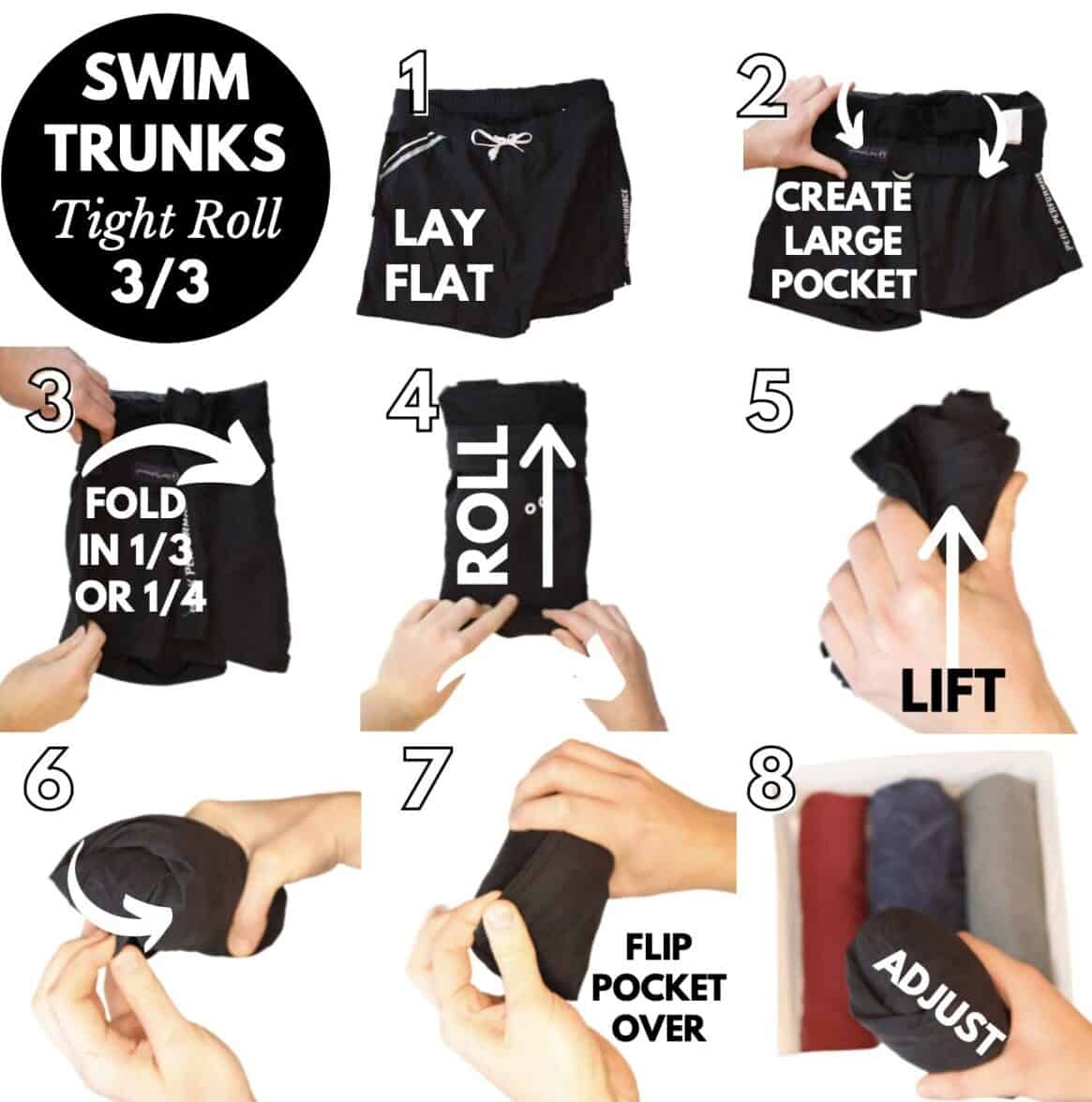
- Turn the waistband inside-out
- Pull the waistband down 3-5″ over the rest of the shorts.
- Fron the left side of the shorts, fold shorts over in half
- From the bottom of the legs, tightly roll the shorts up to the top.
- Flip the exposed part of the inside-out waistband back over the rest of the roll
- Make adjustments with your fingers to even out any wrinkles that have appeared
I shared this ranger roll in the shorts folding guide from the previous lesson as well. As you can see in the video below it saves a ton of space when folding swim shorts as too! You just need to be very aware of the mash and the pockets that tend to fall out when you create the pocket on top.
I recommend that you practice this fold a few times as it can be tricky in the beginning.

How do you fold board shorts?
Boardshorts can generally be folded three ways. The simplest way is to fold it in half from left to right, then once more in half from top to bottom. This makes a flat fold.
I prefer to file-fold boardshorts as they are longer than regular swim trunks. Follow the steps described below to file-fold:
- Lay your boardshorts flat with the front facing up.
- From the left, fold over in half so the back is now facing up.
- From the waistband down to the bottom of the shorts fold downwards one third of the way at a time.
- You now have a file-fold with one fold on one side, and one fold and the bottom of the shorts legs on the other side.
- Place the shorts vertically with the side with the shorts’ legs downwards to support the shorts.
- You can place additional file-folded boardshorts next to this one to created more structure for the folded shorts.
This is a quick and easy way to organize your boardshorts that also saves some space over the regular flat fold.
If you want to fold your shorts for travel, I recommend doing a ranger roll instead as that will hold the shorts really nicely together. Unfortunately, the file-fold is a bit flimsy and will unravel easily. The ranger roll holds together really well. This is my personal favorite, I made an entire guide on how to roll clothes for your dresser actually.
I have added an infographic below on how to ranger roll swim trunks, but it is exactly the same for board shorts, except you don’t have to deal with the mesh inside regular trunks.
Do you wear anything underneath board shorts?
Generally, you don’t have to wear anything underneath board shorts if they have a mesh liner. If they don’t, many chose to wear underwear, a speedo, or compression shorts under their board shorts.
Why Men’s Swim Trunks Have Netting
The main purpose of the netting in swim trunks is to secure your genitals and keep them out of harm’s way during activity.
Generally, you will find mesh liners in all shorts designed for water activities. Interestingly, board shorts seem to be the only men’s swimwear that does not consistently have the mesh liner inside.
As you can imagine, without the mesh liner things move around freely inside the shorts, and you should therefore substitute the liner with a tight pair of underwear or similar underneath.
How to Fold and Store Two-Piece Bikinis
After experimenting way too much with folding a two-piece bikini I have written up a short step-by-step guide for you to fold and store your bikinis.
- Lay the bikini bottom flat with the thinnest side facing up.
- From the left side, fold the bikini bottom over in half so it lines up with the right side.
- From the top, fold it in half down to the bottom.
- For your bikini top, lay it flat with the back facing up.
- Tuck the shoulder straps inside the cups of the bikini top.
- If possible, fold the lower part of the bikini up, over the cups.
- Place the bikini bottom inside one of the bikinis cups.
- Fold the empty cup over the cup with the bikini bottom inside.
- Place the set in a thin cotton bag or a clear, lockable plastic bag.
This is the closest thing we can get to file-folding two-piece bikinis while storing them together. I think it is a great compromise that saves a ton of space, keeps the sets together and organized, while also protecting the cups, and allowing for an easy grab before you head to the beach.
I have also made a video and step-by-step illustration for this folding and storing style for you below in case you are a visual learner.

I also have a guide on how to fold women’s underwear that will interest you. Feel free to check it out next.
How to Fold a Bathing Suit
After tinkering with one-piece bathing suits for a good while I can confidently say that in general, the best way to fold bathing suits is to file-fold them.
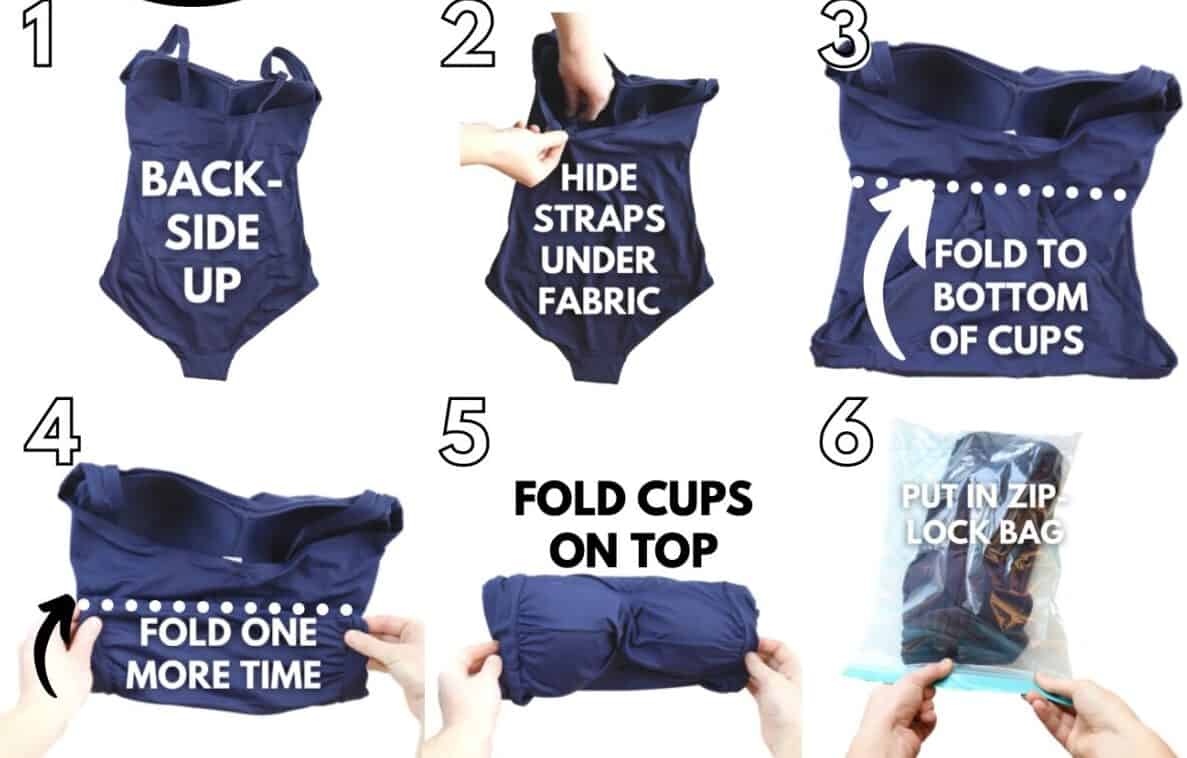
- Place the bathing suit on a flat surface with the back-side facing up.
- Put the shoulder straps neatly inside the cups of the bathing suit.
- From the bottom up, fold the swim suit up in half so it reaches the bottom of the cups.
- Fold it over from the bottom up so it barely meets the bottom of the cups one more time.
- Fold the cups over the rest of the fold, and gently push any acces fabric under the cups.
- Optional: Place bathing suit in a lockable bag for easy storage and access.
To store swimsuits I recommend getting a thin cotton bag or a clear plastic bag with a zip on it. Not only does it allow easier access and organizing, but it will also hold the bathing suit fold nicely together. Sometimes file-folds have a tendency to unravel when you pull out one of the other clothes placed next to them.
If you want to see a visual demonstration of how to perform this fold, I have also added a video above. It is the same video as the one for two-piece bikinis. You can skip to 3:34 if you only want to see the bathing suit fold.
I have also added an illustration below in case you prefer that. You can download all the illustrations from this article at the bottom of the article.
Tap here to check out my guide on how to fold towels.
Why Do Bathing Suits Lose Elasticity?
Generally, bathing suits contain a lot of elastics. As elastic is a rubber product, over time UV light from the sun, as well as chemicals often found in pools will degrade the elastics in your bathing suit. Another common reason is that it is stretched by for example wearing a bathing suit that is too small.
To preserve your bathing suits for as long as possible, you should wash it after use in pools with chemicals. Always follow the instructions on the bathing suit, as too hot water or the wrong chemicals could damage the elastics further. And of course, make sure you wear a bathing suit that fits you.
Folding and storing swimwear will also extend the lifetime of the elastane since it won’t create unnecessary strain. I also have a guide on folding underwear you can check out.
Do Swimsuits Shrink When You Wash Them?
Generally, swimsuits don’t shrink when you wash them as most are made of polyester or nylon which does not shrink. If your swimsuit of made of cotton or wool you may be able to shrink them slightly during a wash.
Your biggest concern should be to preserve them as long as possible, as they usually lose elasticity over time.
How to Know When a Swimsuit is Too Small
As a rule of thumb, if your bust starts spilling out of the swimming suit, or if it leaves red marks after use, it is too small. You should be able to slide a finger under the swimsuit. You want it to sit snugly, but not tight.
Here is a free downloadable cheat sheet for swimwear! Check out the full premium folding guide for more.

I’m an expert wardrobe organizer and a bit of a clean freak. I created this website and its YouTube channel to share practical guides about laundry and organizing. My teachings have been featured in multiple large news publications, and I’ve self-published two wardrobe organizing books and an entire course on the subject.