While laundry detergents are great for washing clothes, they have their significant downsides. They are formulated with harsh ingredients and packed in non-compostable plastic jugs.
This makes them harmful to humans, animals, and the environment. If we were to reduce issues associated with laundry detergent use, there must be an alternative.
Enter laundry sheets. Laundry sheets are the solution to this problem. They are eco-friendly, affordable, and easy to use.
That is why we dove into the market to bring the best among them. Read on to learn the top laundry detergent sheets currently on the market.
The best laundry detergent fulfills several parameters when compared with their peers. They are affordable, deliver more wash loads, are cruelty-free, and are eco-friendly.
List of the Best Laundry Detergent Sheets
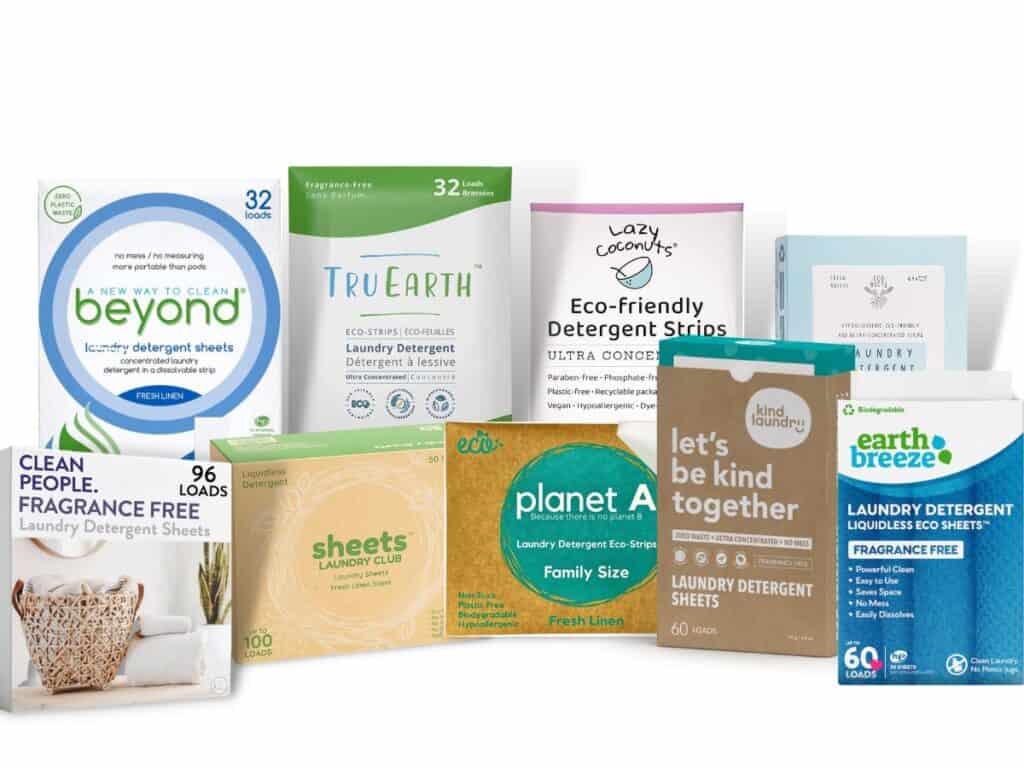
Here now is our pick of the best laundry detergent sheets available in the market.
1. Earth Breeze
Earth Breeze is our no.1 choice for the best laundry detergent sheets. Considering the determining parameters, they are a cut above their competitors.
In our research, the brand showed a remarkable level of performance on most types of soil and stain removal, affordability, the number of wash loads, and above all, they are eco-friendly.
One of the greatest benefits of using earth breeze is its affordability. At $0.33 per washload, it is one of the cheapest laundry sheets on the market.
And to sweeten the deal, they offer a fantastic monthly subscription plan that plummets the cost per wash load even further to $0.20.
Check out their subscription plan here.
I found this a fantastic offer considering some in the competition charge as high as $1 per load.
When it comes to its cleaning power, earth breeze has a clear score over other laundry detergent sheets.
The detergent showed tremendous results in cleaning a wide variety of soils on both white and colored clothes. And the best part is you only require half a sheet for the regular load, reserving the full sheet for the heavy load.
And when it comes to safety for use, Earth Breeze is hypoallergenic, paraben-free, phosphates-free, cruelty-free, and versatile for use in all types of washing machines.

Moreover, they are among the frontline eco-friendly detergent manufacturers. Their green practices in the manufacturing process are numerous.
Its formulation is all based on plant-based active ingredients with no harmful effects on the environment.
And unlike some of its competing products, theirs is packaging composed of compostable materials, which is a huge score in the global effort at reducing the overflow of landfills.
Furthermore, they take the corporate environment and social responsibility a step further in several ways.
For instance, they donate a part of sales revenue to the less fortunate in society and the calamity-stricken parts of the world.
Also, they are active members of the 1% For The Planet, an organization formed by like-minded corporations that commit 1% of their profit to environmental conservation.
Another one is they have a carbon-neutral status, adding another feather to their eco-friendliness achievements.
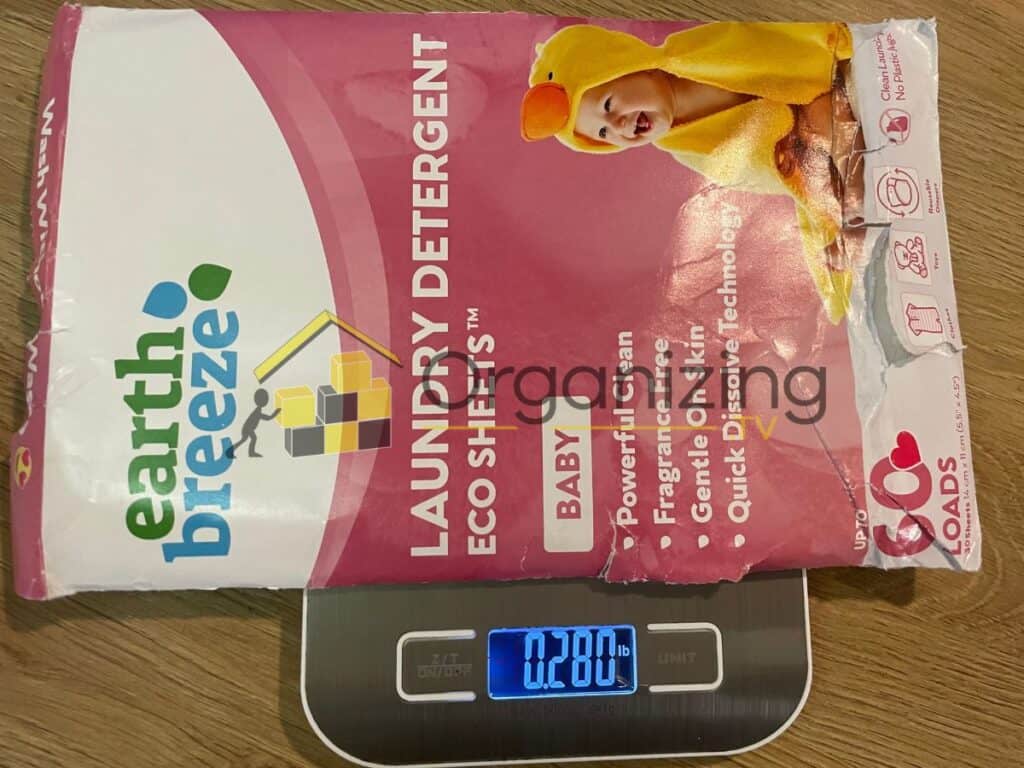
From their lightweight, green packaging to office designs to the entire delivery process, theirs is a firm commitment to ethical and environmentally friendly production.
Pros
- Cheap laundry detergent sheets
- Eco-friendly formulation and packaging
- Active in helping the less fortunate, and calamity-stricken communities
- Safe for human use with no side effects
- Versatile for use for all types of machines
Cons
- One user reported their clothes getting dingy after using the laundry sheet.
Point To Note
Earth breeze is the overall winner when evaluated on several key parameters. As we found out, its performance in washing laundry, affordability, ethical production, and corporate commitment to environmental and social causes are unrivaled.
This is definitely a must-have item laundry detergent sheet for any serious buyer.
2. Kind Laundry Sheets
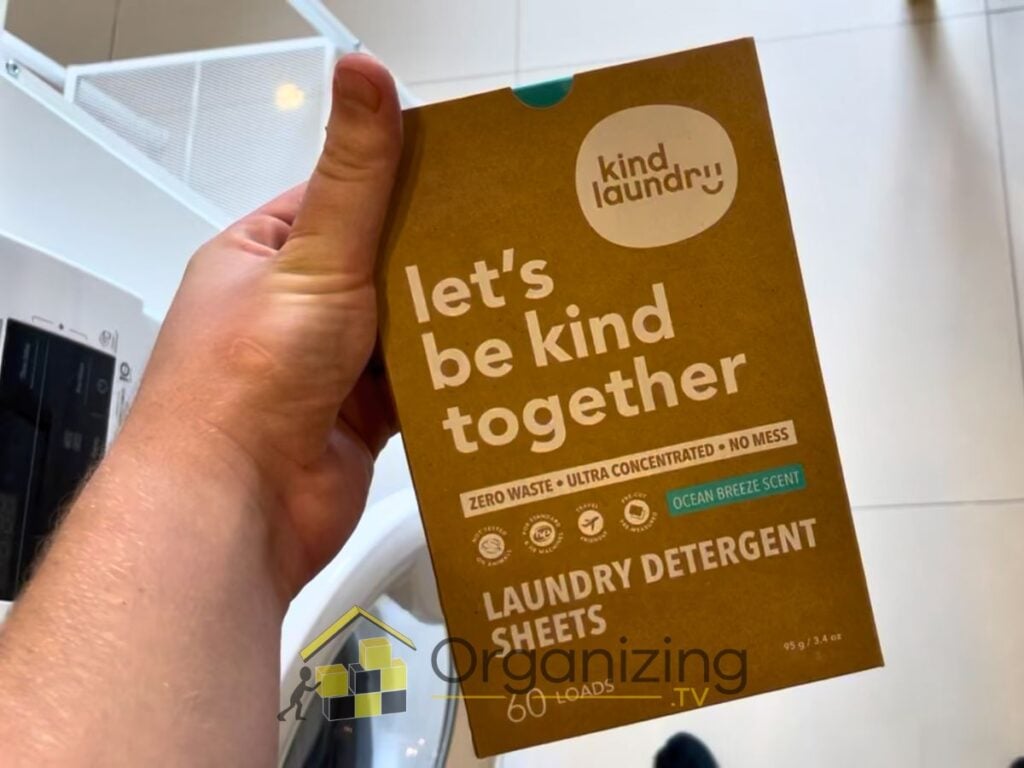
Kind Laundry Sheets derived its name from the ideological conception of its founders for a kind laundry detergent. The ‘kind’ implies mildness to the laundry, the skins, and eco-friendliness.
And that explains their unique production processes. First, theirs is an entirely organic formulation boasting of plant-based extracts and surfactants.
Some of them include SDS, glycerol, and decyl glucosides.
Moreover, these organic surfactants proved to be effective when tested against the inorganic-based traditional detergents.
On affordability, for one-time buying, they stand toe to toe with the Earth Breeze. With 60 loads, that comes to about $0.33 per load for a single purchase.
However, when evaluated on the cost-effectiveness of a monthly subscription, theirs comes to $0.28, making it pricier than the Earth Breeze, which is $0.20.
You can get their subscription plan here.
Next is their exceptional packaging model consisting of 100% plastic-free compostable packaging. This means less pollution to our land and oceans and its adverse effects on natural life.
Furthermore, for safe use, they are designed without harsh chemicals and additives. That means it is among the mildest detergent to use, even for people with sensitive skins.
And when it comes to fragrances, they have two options for you. You can go for the fragrance-free or ocean breeze if you like a tinge of natural oceanic fragrance in your wash.
On the versatility front, this is one of the most adaptable laundry sheets as they can function in hand washing, standard, and HE washing machines.
And for those who would want to do sampling before buying whole packs, you are in luck. The company allows you to buy travel pack samples before deciding to go full board.
Another deal sweetener is getting a 10% discount for opting in for their newsletter. The downside is free shipping is only available to subscription customers.
One-time buyers have to foot the shipping bill, which is an added cost, which is an addition on cost.
Pros
- It is produced with ethical and eco-friendly considerations.
- Cheap for one-time buyers.
- 10% for newsletter opt-in.
- A choice of two forms; fragrance-free and ocean breeze.
- Buying travel packs before buying a full pack is allowed.
Cons
- No clear policy on donations to eco-friendly charities or memberships in environmental organizations.
- Free shipping policy, this is only for the monthly subscribing customers.
- A subscription is more costly than a one-time payment.
Point To Note
Kind laundry sheets may have some downsides, but it is also backed by some strong points, as we’ve found out above. If you are looking for terrific frontrunner laundry sheets, do not look past this one.
3. Tru Earth
Tru Earth is another of the best choice laundry detergent sheets. We found the product to have lots of strong points, which would make it a favorite for anyone looking for great laundry sheets detergents.
As the name suggests, this is another of the genuinely eco-friendly and safe-to-use laundry sheets. They have an entirely organic and zero wastage policy, with no use of plastic materials in any part of the packaging process.
On social policy, it is also praiseworthy as they offer 32 loads of laundry detergent sheets for social causes.
Tru earth laundry sheets have the most sensitive skin consideration in their formulation. It is recommended as a safe choice for people with allergies, eczema, and other skin disorders.
Furthermore, it is cruelty-free and devoid of any of the harsh inorganic chemicals found in some traditional detergents.
On effectiveness on cleaning, Tru Earth delivers phenomenally. This is all thanks to its smart formulation that obliterates even some of the toughest soils.
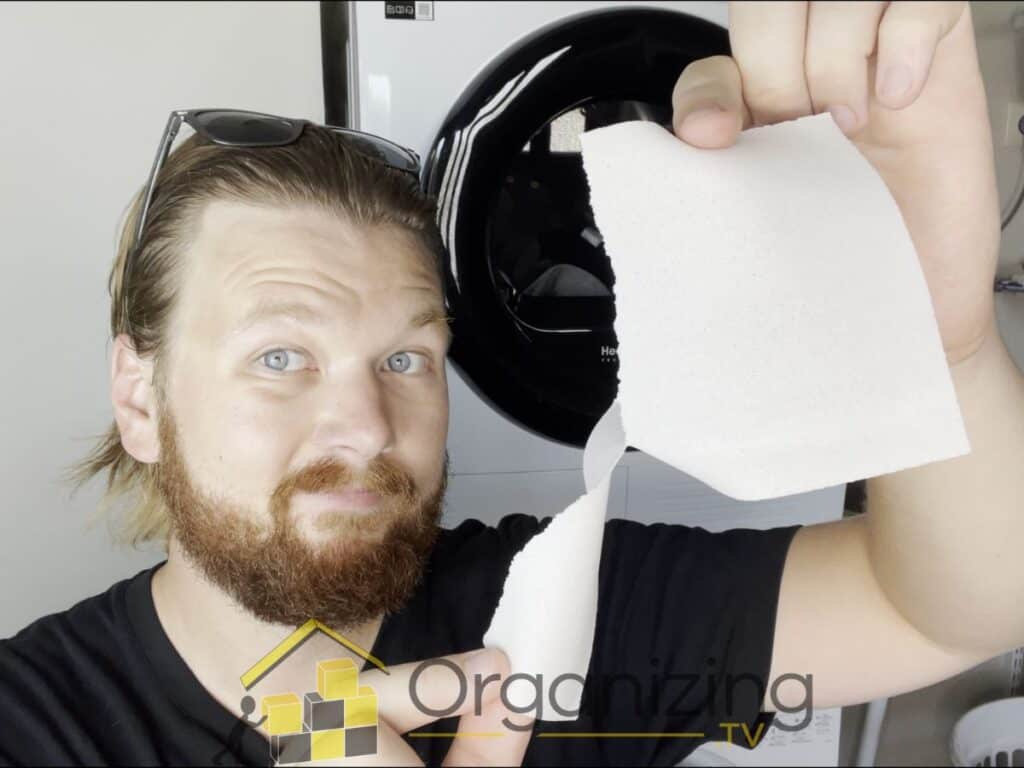
With a single sheet delivering a large clean wash, you won’t want to use another option. That makes half a sheet sufficient for the average load.
For comparison, an average strip weighing 3g is equivalent to 40g of heavy-duty liquid or powder detergent.
While a great product, Tru Earth has some downsides as well. For example, at 0.62 per wash load, it is much more expensive than some high-performance laundry sheets, such as the Earth Breeze.
In addition, their donation policy towards environmental matters is not as generous as some of the others we have discussed in this review.
For example, Earth Breeze offers donations as well as support to aid-based organizations.
Pros
- Organic and zero wastage policy for a greener earth
- Formulated for safe skin
- Smart formulation removes heavy soils.
- Ultra-concentrated for hence more cost-effective
Cons
- More expensive than some high-performing brands.
- No robust donation towards environmental conservation causes.
Point To Note
Tru earth is a great laundry sheet worthy of your money. Other than the two downsides we noted above, the product offers a wide range of wonderful benefits worth trying on your laundry.
4. Sheet Laundry Club
Sheet Laundry debuted in 2019 with a proposal to create earth-friendly laundry detergent. This was in their pitch to the reality TV show Shark Tank, and the rest, as they say, is history.
Fast forward, and here we are with one of its innovative products, the Sheet Laundry Club.
In our analysis, these laundry sheets are up to their billing as eco-friendly sheets. What with their product that is plastic free, recyclable, and equipped with the plant-based formulation.
Speaking of formulation, its three main active ingredients; anionic surfactants, non-ionic surfactants, and enzymes, give the detergent sheet a killer punch over most stains.
From greasy, grime, or sticky soils on clothes, they can obliterate all. And since it’s ultra-concentrated with surfactants, you do not have to use the whole sheets unless on large loads of clothes. Consequently, it is cost-effective and convenient to use.
To add to its cost-effectiveness, they are among the cheapest brands in the market. The cost per wash load averages $0.40 for one-off purchases and $0.28 for subscription-based purchases.
Pros
- Ultra Concentrated for heavy soils and stain removal.
- Cost-effective with low cost per wash load.
- Flexible and convenient for use; you can tear ½,¾ per wash load.
- Fresh, natural smell.
- Eco-friendly packaging.
- It is manufactured in the US.
Cons
- Shipping is only free for orders above $12.99.
- The product is not readily available offline.
5. Beyond Laundry Detergent Sheets
Beyond Laundry Detergent Sheets ticks all the qualifications for great detergent sheets. First, its performance in washing whites and colors fared quite well, even when used on heavily soiled clothes.
One sheet is sufficient for the standard soils and rarely two for the heavily soiled clothes. This is due to its ultra-concentration in its formulation, ensuring less detergent usage.
And coming to pricing beyond laundry detergent sheets are priced competitively. At $8.99 for 32 loads, that comes to $0.28 for a one-off purchase.
It’s way cheaper than some of the cheapest laundry sheets we have reviewed here.
Considering eco-friendliness, the detergent sheet is not doing badly. Their processing and packaging make all the qualifications for a green product.
They are not tested on animals, have no harsh chemicals, bleach, or dyes, and are USDA bio-certified plant-based products.
Beyond sheets are versatile and designed for all methods of laundry washing, with a standard washer, HE, or hand washing.
Plus, they can easily be tucked into your luggage even when you’re on vacation. Without a doubt, these are laundry sheets worth a try.
Pros
- High-performance results in colored and white clothes
- USDA-certified safe for use
- Works with all laundry washing methods and washing machines
- Ultra-concentrated hence cost-effective
Cons
- Not the cheapest laundry detergent sheet.
- Some customers complained that it doesn’t remove heavy soils.
6. Clean People Laundry Sheets
If you are looking for a premium product, this is it. Clean People Laundry Sheets is a bit pricey, with its cost coming to $1.03 per wash load. But they are backing the price with its strong cleaning power.
With its plant-based concentrated formula, one single sheet delivers a large-sized clean wash load. Plus, you have the convenience of choosing from 32 loads to192 loads, which makes them quite convenient to use.
And when it comes to eco-friendliness and safe use, Clean People sheets lives up to its name. The laundry sheets are devoid of any harsh chemicals, such as parabens, ammonia, or phosphates.
Additionally, the product packaging is as green as it can be. To push it further, they commit to planting two trees for every 192 loads sold.
If you’re not on a budget and you’re looking for reliable laundry sheets, Clean People laundry sheets are a product you do not want to pass.
Pros
- Ethical formulation and testing.
- Robust eco-friendly programs.
- Versatile wash load packs.
Cons
- Expensively priced
7. Eco Roots Detergent Sheets
Eco-roots Laundry Detergent Sheets are other laundry sheets with a strong foundation of friendliness. This is based on the vision of its founders for an organic product with plastic-free packaging.
Additionally, this product is organic, so there is no need to test them on animals. Not to mention they’re custom-made with careful ingredients selection, which rules out the use of harsh ingredients in its production.
Speaking of custom-making, they are well designed for easy folding when cutting in half.
And to entrench their organic foundation, they are members of the 1% For The Planet, where they contribute a portion of their earnings to conservation causes.
When it comes to performance, the product has shown exceptional cleaning power in our tests. One sheet for standard loads is all you need for a clean wash. You can reduce this to half a sheet for smaller loads or a maximum of two for large loads.
And with its cost averaging $0.22 per wash load, this is one of the cheapest laundry detergent sheet brands.
Its cleaning power lies in the ultra-concentrated surfactants that penetrate heavily soils releasing it from the fabrics.
The only downside with Eco-roots from reviews is that they do not dissolve fast in cold water, and it is naturally scented. Some people simply love their clothes coming out with strong fragrances fresh from the washer.
Pros
- Custom-made with a careful selection of ingredients.
- Exceptional cleaning power.
- Have strong ultra-concentrated surfactants.
8. Lazy Coconut Eco-Friendly Laundry Detergent Sheets
Lazy Coconut leverages the organic cleaning power of coconut in its formulation. This is all courtesy of coconut and plant-based surfactants.
And the formulation packs a punch when it comes to cleaning if the raving customers’ reviews are anything to go by. Here is what one user had to say, “they are great for travel, and they do not take up space even when I’m traveling.”
As for eco-friendliness, Lazy Coconut is probably one of the companies which take up the environmental concern a notch higher. Their whole process, from production to delivery, is a zero-wastage process.
Plus, lazy coconut is another versatile detergent that can be used on both standard washers, HE washers, or by hand washing. And considering the $0.30 per wash load, this laundry sheet is worth your money.
Pros
- Incorporates organic cleaning power
- Zero wastage policy
- Versatile for use on both standard and HE washing machines.
9. Planet A Laundry Sheets
Planet A is another family-owned detergent maker on a mission to improve the earth. They are doing this by coming out with innovative products that align with better earth in their processes.
This is because, in their own words, “there is no planet B.”
For starters, Planet A Laundry Sheets are made with plant-based ingredients, packed with recyclable materials, and hypoallergenic.
That means the laundry sheets do not contain any harsh inorganic chemicals, making them suitable for even the most sensitive skins.
On cleaning power, the sheets are ultra-concentrated, which gives incredible cleaning power when compared with some major competitors in the market.
For instance, its 2g laundry sheet is equivalent to 130 g of ordinary detergent. And all this costs $0.21 per wash load, making it one of the most attractive laundry detergent sheets deals.
If you are looking for a product that is easy to use, economical, eco-friendly and does a thorough job of cleaning eleven of the toughest of dirt, then grab this one.
Pros
- Recyclable packaging
- Strong cleaning power
- Easy to use and economical
What Are Laundry Detergent Sheets?
If you’re new to this form of laundry, we should probably do some explanation on what it is. Laundry detergent sheets are made from the modern ultra nano-concentration technology of laundry production.
With this technology, organic surfactants and additives are concentrated into solids. They are then precut and premeasured into sheets, each of which represents a wash load. These easily dissolve in water during washing to clean clothes.
Advantages of Laundry Detergent Sheets to Liquid and Powder Detergents
As we have seen above, all laundry sheets are not equal. In a toe to toe comparison, some have clear, strong points over others.
But how do laundry detergent sheets fare in comparison with other types of laundry detergent, such as powder and liquids? Let’s start with the advantages.
Convenience
Using laundry detergent sheets is the most convenient way of doing laundry. Laundry sheets are premeasured, with each sheet equivalent to one load.
Consequently, there is no more second guessing, spillages, or messes associated with traditional detergents. What that means is precise and clean wash every time.
Environmental Friendly Product
This is one of the key points associated with this type of laundry detergent. Eco-friendliness is taken into consideration at every stage in most laundry detergent sheets making processes.
From formulation, manufacturing, and packaging to delivery. That is why their formulation is entirely organic, packaged in compostable cardboard, and devoid of plastic in any part of its packaging.
That means zero waste packaging, which is environment-friendly.
Safe for Use Products
Few laundry detergents are as safe for human use as laundry sheets. All the ingredients are organic with no toxic additives.
That means no parabens, phosphates, brighteners, dyes, ammonia, and other inorganic chemicals found in the traditional laundry detergents.
This makes them the safest for use for everyone, including people with skin sensitivity, eczema, and other skin allergies.
Easy Transportation and Storage
When it comes to transportation and storage, laundry detergent beats other types of detergents, hands down.
Whether you are traveling on vacation or just on a short trip, lugging a detergent jug along is harder than laundry detergent strips.
With sheets, you can easily tuck 32 or more wash loads worth of laundry detergents in your handbag with no worries of spillages.
Furthermore, if you live in a small house, you don’t have to worry about extra storage spaces for laundry jugs at all.
Ultra Concentrated
Most laundry detergent sheets are ultra-concentrated. That means you only need to put a smaller amount of detergent in comparison to the standard detergents.
In most brands, the difference can be as huge. For instance, one laundry detergent sheet that weighs 2g can be equivalent to 130g of liquid or powder detergents.
This form of nano concentration technology ensures you only need to use a little, unlike the bulk doses required for the other forms of detergents.
Disadvantages of Laundry Detergent Sheets
Costly
One of the main demerits of laundry detergent sheets is that they are pricier when compared to standard detergents. But considering other factors, it turns out they are more cost-effective in the long run.
Not Readily Available
Laundry sheet makers have not been able to meet the growing demand and sustain the product in the market. As such, the demand has caused scarcity in both online and offline marketplaces. This has caused inconvenience to buyers.
Laundry Detergent Sheets vs. Pods: Which Is Better?
There is an unending debate out there on which is better between detergent sheets and pods. While each has its own merits, which is the most preferable?
Let us find out by comparing them based on some key parameters below.
Ingredients
Pods are simply premeasured, concentrated packets of laundry detergents. That means it contains the same ingredients as standard laundry.
The only difference is the water content level, which averages 10% compared to 50% in ordinary standard detergent.
Consequently, since most laundry detergents are formulated with harsh inorganic ingredients harmful to humans and the environment, pods are no different.
They are merely emulsifiable laundry detergents, inclusive of the harsh ingredients.
Some of the chemicals found in pods include;
- Sodium silicate(water glass)
- Sodium carbonate(soda ash)
- Sodium perborate
- Various phosphates
In contrast, laundry sheets contain organic ingredients in their formulation. Below are typical examples of ingredients in laundry sheets.
- Dodecanol- these coconut oil-based fatty acids which is a natural surfactant.
- Polyglycerol ether- another coconut-based mild surfactant for removing stains and stubborn soil.
- Polyvinyl alcohol- also known as PVA, is a water-soluble synthetic resin used to bind the ingredients during the process of creating the sheets.
- Deionized water- for preventing salt and mineral build-up.
Eco-Friendliness
Other than laundry detergent sheets having mild organic ingredients, the packaging modes are also different for the two types of detergents.
Pods always use some forms of plastics in their packaging. For instance, plastic pouches or tubs with plastic lids all end up in environmental contamination.
In contrast, laundry sheet production is plastic-free in all its stages, with most of its components, including packaging being biodegradable.
Use Safety
Unlike laundry sheets, harsh chemicals in pods can cause health problems, including allergic reactions in children and people with low immunity. Even the design makes them look like candy, which can tempt children to want to eat them.
Laundry Performance
The performance of laundry sheets is at par with laundry pods. However, the only downside is that sheets are more expensive on average.
But with the benefits of laundry sheets increasing over those of pods, we would recommend using laundry sheets any day.
I have also made a comprehensive comparison between laundry pods, liquid, and powder that may interest you to check out.
Can You Use Laundry Detergent Sheets in a Sink?
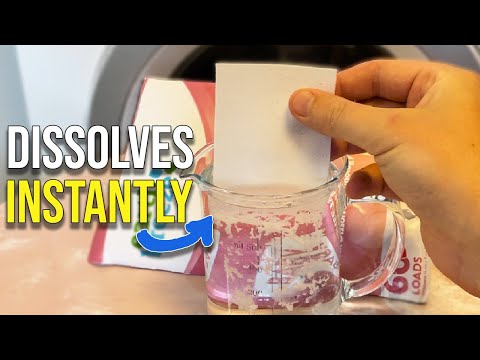
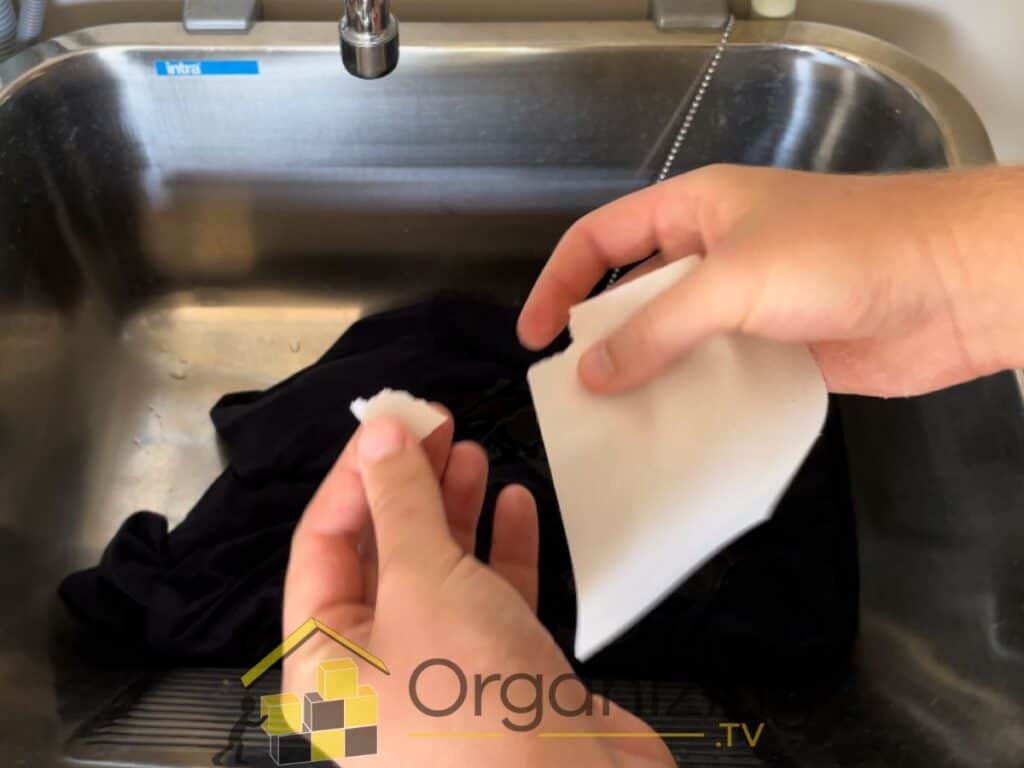
Laundry detergent sheets work best in washing machines, making them look inappropriate when used in a sink. But that aside, unlike most powder detergents, they are emulsifiable in water.
So once that happens, you can use the solution to wash the clothes as normal.
How Long Do Laundry Sheets Last?
Laundry sheets have a higher shelf life in comparison to liquid and powder detergents. With laundry sheets, you can expect them to retain potency for up to 2 years from their date of manufacture.
In comparison, the other forms of detergents can last up to a year in the original container and much less(approx. 6 months) once the container is opened.
More on whether laundry detergent expires or not here.
How to Use Laundry Detergent Sheets the Right Way
This might sound obvious to some people, but the fact is, not everyone knows how to use laundry detergent sheets properly. If you’ve never used laundry sheets before, here is how to do it.
- First, sort your clothes as usual and add them to your laundry machine, followed by the right amount of water.
- Next, put in the washer drum the correct number of laundry detergent sheets. This will depend on the level of soil and wash load size. Usually, one sheet is sufficient for a standard wash, but for smaller wash loads, you can cut the sheet into equal halves.
- Finally, start the washer on and run the normal cycle. It is that simple! No guessing on the right doses, no messy spillages, or tagging along heavy laundry detergent jugs after washing.
Frequently Asked Questions
Do Laundry Detergent Sheets Work?
Laundry detergents are more effective than ordinary detergents on many levels. They are ultra concentrates, meaning you only need a small quantity of laundry detergent for the average load.
This contrasts with ordinary detergent, where you need a large amount for the same level of wash. Plus, they are more penetrative into the clothes fiber to dislodge the soil.
Are Laundry Sheets Safe for HE Washing Machines?
Laundry detergent sheets can safely work with any laundry washing method. They work well in standard HE washing machines as well as in hand washing.
For the top loading machines, you can throw the laundry strip into the drum, while for the HE machines, you can cut the laundry sheets into a few pieces and put them into the laundry detergent dispenser.
Do Laundry Detergent Sheets Remove Stains?
Laundry detergent sheets are highly concentrated organic surfactants that penetrate deep into the clothes fabric. As such, they lift all stains from the fabric, leaving them crisp and clean.
That means they do not require combining with other cleaning agents, such as stain removers, for them to work.

I’m an expert wardrobe organizer and a bit of a clean freak. I created this website and its YouTube channel to share practical guides about laundry and organizing. My teachings have been featured in multiple large news publications, and I’ve self-published two wardrobe organizing books and an entire course on the subject.